

Look!
Knowest thou the condescension of God?


Sometimes it is our most painful experiences that provide us with the kind of tutorials that only discomfort can deliver.
Although it has been more than 45 years ago, I still remember sitting in front of three older men I knew who were reviewing my application to receive the Eagle Scout recognition. (Full disclosure —My parents are in fact the ones who earned it. The personal effort I expended was exceptionally tepid. Sorry Mom!)
As the review progressed, one of the three asked me a question. Without looking at him I responded in a mumble.
I’ll never forget what he did next. His name was Jack.
“Look at me, Scott! You need to look at people when they are talking to you. Please answer the question again and look at us while you are speaking.”
I was stunned.
Wha…what? You want me to look at you? Meaning actual eye contact? But I’m so…that’s scary. You’re scary. I don’t want to.
Jack’s piercing directive exposed one of my hidden weaknesses. I feared adults and what they thought of me. I was sure they all disliked me and wanted to do me harm. At some point I had discovered that if you didn’t look directly at people, they might ignore you altogether—a far better option than getting called out for being an idiot. (I don’t think this ever actually happened to me, which at the time would have been confirmation to my very underdeveloped mind that not making eye contact was working. 👀)
(By the way, I knew even then that Jack loved me. A lot. I have no idea why. He was always so loving and affectionate when I believed I deserved neither love nor affection. He also loved me enough to challenge me to be better. I will love him forever for that.)

I still think about that experience these many years later when I am talking to someone and find them (or myself) looking around instead of making eye contact. I am especially sensitive to this when speaking with young people. I can empathize with their struggle to look at adults. I remember how hard that can be.
This little scene returned to my memory recently as I was reading one of my favorite chapters in The Book of Mormon-1 Nephi 11.
Nephi was a young man at the time, perhaps the same age I was when Jack told me to look directly at people when speaking to them. Nephi had just heard his father Lehi recount a remarkable vision he’d been given about the Tree of Life and naturally wanted to have his own experience. As Nephi’s vision began, he was visited by the Spirit of God and asked several important questions:
2 And the Spirit said unto me: Behold, what desirest thou?
3 And I said: I desire to behold the things which my father saw.
4 And the Spirit said unto me: Believest thou that thy father saw the tree of which he hath spoken?
5 And I said: Yea, thou knowest that I believe all the words of my father.
Nephi’s life was about to change forever.
8 And it came to pass that the Spirit said unto me: Look! And I looked and beheld a tree; and it was like unto the tree which my father had seen; and the beauty thereof was far beyond, yea, exceeding of all beauty; and the whiteness thereof did exceed the whiteness of the driven snow.
This was soon followed by a question any believer could profitably ponder:
14 And it came to pass that I saw the heavens open; and an angel came down and stood before me; and he said unto me: Nephi, what beholdest thou?
15 And I said unto him: A virgin, most beautiful and fair above all other virgins.
16 And he said unto me: Knowest thou the condescension of God?
Nephi’s response reflects his meekness:
17 And I said unto him: I know that he loveth his children; nevertheless, I do not know the meaning of all things.
His unnamed angelic tutor responds with unbridled joy: Look! Look! Look!
(You should actually count how many times he tells Nephi to “Look!”)
But it’s what (or who) Nephi sees when he looks that matters. It’s Jesus. His birth. His ministry. His teachings. Nephi sees the Son of God “going forth among the children of men” (1 Nephi 11:24,) having a full mortal experience, culminating in his crucifixion.
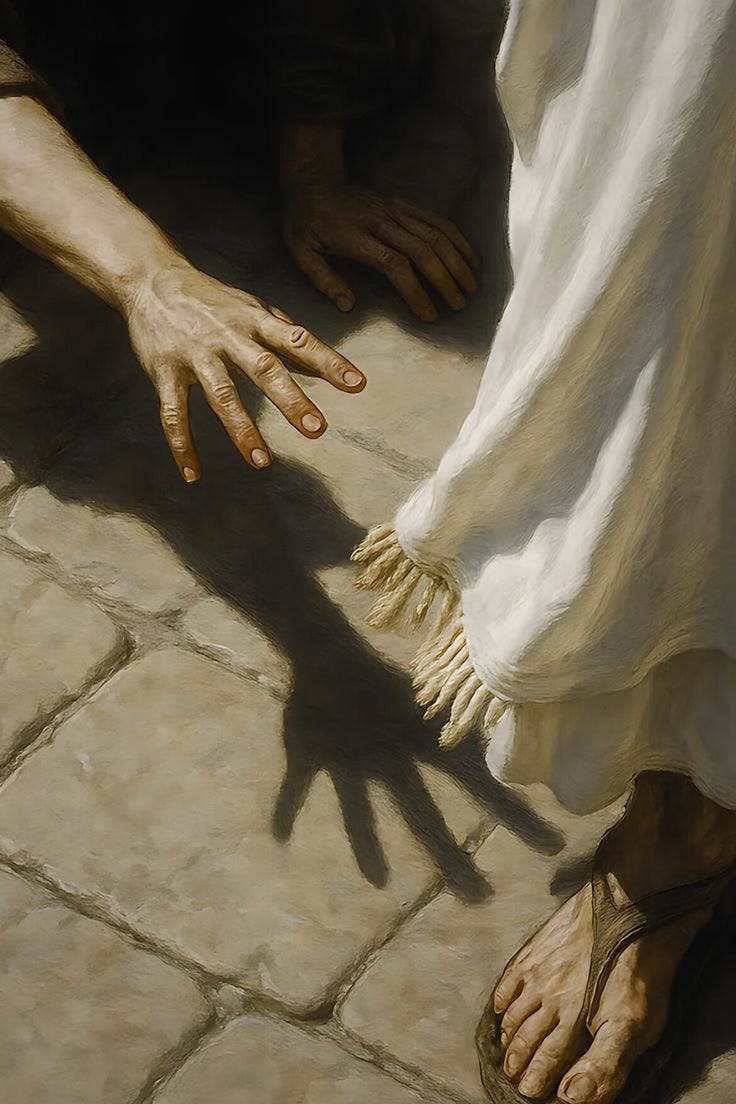
Here’s my takeaway: When I am afraid, or when I feel doubt, or when I am struggling to believe—Look! Jesus and His prophets teach us this over and over. Look vertically, not horizontally. Fix my gaze on the Lamb of God.
Here’s how another prophet put it:
19 Behold, he was spoken of by Moses; yea, and behold a type was raised up in the wilderness, that whosoever would look upon it might live. And many did look and live.
20 But few understood the meaning of those things, and this because of the hardness of their hearts. But there were many who were so hardened that they would not look, therefore they perished. Now the reason they would not look is because they did not believe that it would heal them.
21 O my brethren, if ye could be healed by merely casting about your eyes that ye might be healed, would ye not behold quickly, or would ye rather harden your hearts in unbelief, and be slothful, that ye would not cast about your eyes, that ye might perish?
22 If so, wo shall come upon you; but if not so, then cast about your eyes and begin to believe in the Son of God, that he will come to redeem his people, and that he shall suffer and die to atone for their sins; and that he shall rise again from the dead, which shall bring to pass the resurrection, that all men shall stand before him, to be judged at the last and judgment day, according to their works.
Alma 33
There’s that word “look” again. I especially love the phrase in vs. 22: “Cast about your eyes and begin to believe in the Son of God.”
President D. Todd Christofferson just gave one of the most marvelous discourses ever given about the condescension of Jesus. You would no doubt benefit far more from reading what he had to say about this than anything I might share, so if you are picking between D. Todd and Scott A., there’s only one right answer.
It is all but impossible to grasp the magnitude of our Savior’s condescension. Imagine a divine being with intelligence and power sufficient to create this earth, a planet capable of sustaining billions of our Father’s children and many other creatures over many thousands of years. Now He lays aside His glory and powers and descends to His creation, His “footstool,” as a helpless babe, born in a humble stable with a manger used to feed animals as His cradle.
He experiences what all of us experience: growing over time in consciousness and capacity—developing from infancy to childhood to youth to adulthood. As the Only Begotten Son of God (God being the Father not only of Christ’s spirit but also of His body), Jesus’s learning is more rapid and advanced than anything even the brightest of us have ever experienced; yet it is for Him, as for us, not instantaneous.
The scriptures record that he received not of the fulness at the first, but received grace for grace; And . . . continued from grace to grace, until he received a fulness.
In this state of condescension, Jesus of Nazareth experiences hunger and deprivation, fatigue and pain, persecution and rejection. In Isaiah’s words, He is “a man of sorrows, and acquainted with grief.” On one occasion, Jesus laments, “The foxes have holes, and the birds of the air have nests; but the Son of man hath not where to lay his head.” So He lies in the very dust that is the least of His creations. In the end, He is “led, crucified, and slain, the flesh becoming subject even unto death.”
And why this incomprehensible condescension? Could not Jesus have performed His infinite Atonement, so fundamentally crucial to our immortality and eternal life, without also having to experience mortality from birth to adulthood? Could He have simply come as a man rather than as a babe and still have accomplished His atoning mission? I cannot say, but surely it is by divine design that the Son of God lived a life and performed a ministry that not merely tell us but show us the way of discipleship, the way to God. Beginning with His own baptism, witnessing “unto the Father that he would be obedient unto him in keeping his commandments,” He not only taught but demonstrated what it means to walk the covenant path. Throughout His life, culminating in His suffering and death on the cross, “he descended below all things, in that he comprehended all things, that he might be in all and through all things, the light of truth.”
And so “we have not an high priest which cannot be touched with the feeling of our infirmities; but was in all points tempted like as we are, yet without sin.”There is nothing we experience that He does not comprehend and that He does not have power to address and redress. He knows; He understands; His love is perfect.
I don’t know about you, but right now things are pretty heavy and dark in my neck of the woods. There are many whom I love deeply who are fighting a hard fight. My work is to love them and pray for and with them and to do all in my power to mourn with them and comfort them.
If any of them are reading this, I say to them (and to all) with love—Look! It is so easy to slip into fear mode and so hard to break free. But this is the message we need most right now: Looking to Christ in every thought, every challenge, every sorrow, and every heartbreak is the best way to feel hope no matter how hard the moment may be.
Christ the babe was born for you. Merry Christmas, beloved ones.
𝐹𝓁𝑜𝒸𝓀𝓈 𝓌𝑒𝓇𝑒 𝓈𝓁𝑒𝑒𝓅𝒾𝓃𝑔, 𝓈𝒽𝑒𝓅𝒽𝑒𝓇𝒹𝓈 𝓀𝑒𝑒𝓅𝒾𝓃𝑔
𝒱𝒾𝑔𝒾𝓁 ‘𝓉𝒾𝓁 𝓉𝒽𝑒 𝓂𝑜𝓇𝓃𝒾𝓃𝑔 𝓃𝑒𝓌
𝒮𝒶𝓌 𝓉𝒽𝑒 𝑔𝓁𝑜𝓇𝓎, 𝒽𝑒𝒶𝓇𝒹 𝓉𝒽𝑒 𝓈𝓉𝑜𝓇𝓎
𝒯𝒾𝒹𝒾𝓃𝑔𝓈 𝑜𝒻 𝒶 𝑔𝑜𝓈𝓅𝑒𝓁 𝓉𝓇𝓊𝑒
𝒯𝒽𝓊𝓈 𝓇𝑒𝒿𝑜𝒾𝒸𝒾𝓃𝑔, 𝒻𝓇𝑒𝑒 𝒻𝓇𝑜𝓂 𝓈𝑜𝓇𝓇𝑜𝓌,
𝒫𝓇𝒶𝒾𝓈𝑒𝓈 𝓋𝑜𝒾𝒸𝒾𝓃𝑔, 𝑔𝓇𝑒𝑒𝓉 𝓉𝒽𝑒 𝓂𝑜𝓇𝓇𝑜𝓌
𝒞𝒽𝓇𝒾𝓈𝓉 𝓉𝒽𝑒 𝒷𝒶𝒷𝑒 𝓌𝒶𝓈 𝒷𝑜𝓇𝓃 𝒻𝑜𝓇 𝓎𝑜𝓊.

I really like this. I work with Latter-day Saint history, especially the those Saints who lived in the 19th century. For example, I think about how there are times in the documents, I can tell that Brother Brigham is stressed and worried about the future of the Church. But one thing that comes through even in moments when it seems the US Government is about to destroy the Church, He talks about Christ and how the Lord makes a way for the Saints to make it through. Anyways, long comment, but thank you for the work you are doing!